Love Machine
Thoughts on 'A.I. Artificial Intelligence' in View of an Upcoming Online Event

Film lovers tend to dismiss A.I. Artificial Intelligence by saying that Steven Spielberg’s involvement distorted Stanley Kubrick’s vision. They point to parts of the film they say Kubrick would never have included had he lived long enough to bring this labour of decades to the screen. Most often, the closing sequence—where the robot David is reactivated by the intelligent machines of a post-human age, who proceed to resurrect his adoptive mother for a day—is cited as a particularly egregious example of the Spielbergian saccharine. This sequence, however, was in the original treatment that Brian Aldiss and Ian Watson wrote under Kubrick’s strigine gaze. There is something in that very sequence which, far from competing with the cineast’s vision, completes it in a kind of mechanical redemption.
My view is that A.I. is truly a Kubrick film, though I confess that this necessitates a conception of auteurship generous enough to include even the choice of who will call the shots on set among the things a properly visionary director directs. “Properly visionary” here means properly attuned to what a film wants—and for evidence of what A.I. wanted, look no further than its title, with its near-perfect isomorphism to that of Spielberg’s own study of nonhuman childhood, E.T. the Extra-Terrestrial. Long before his death, Kubrick made it clear he wanted Spielberg to helm A.I., since it seemed to require a certain sensibility, combined with a knack for visual effects, that he didn’t feel quite capable of bringing to the project. Steven Spielberg, in other words, was a casting choice.
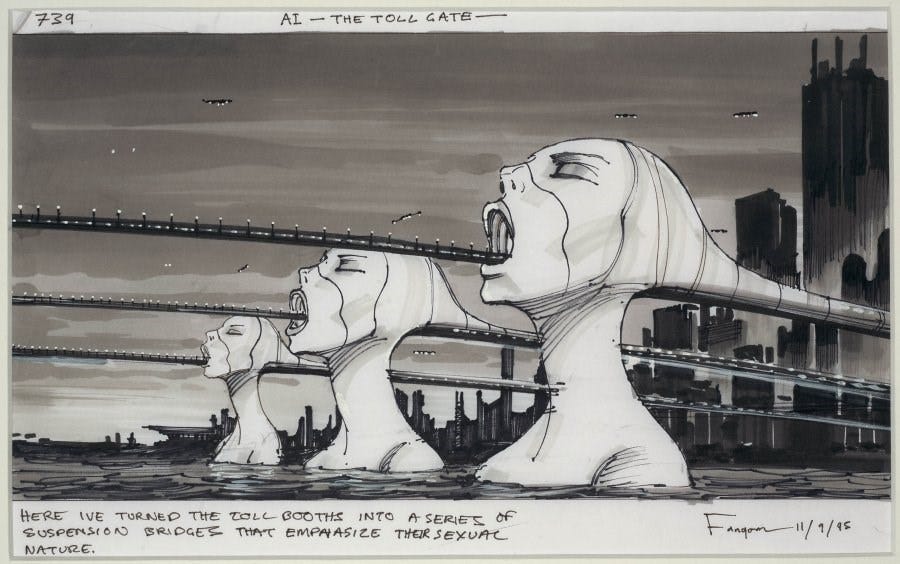
I say this because I think it’s important to consider A.I. Artificial Intelligence in light of the rest of Kubrick’s oeuvre. As I’ve suggested elsewhere, Kubrick was a Brutalist filmmaker, so much so that his fondness for symmetry applied at every level, from the isolated shot to the entire filmography considered as a single work. Just as there is a medial vanishing point in every shot that Kubrick constructed along a perfectly perpendicular z-axis, so there is a midpoint to each film, and also, I’d argue, to the total body of work. Line up all thirteen features (excluding the disowned Fear and Desire but including A.I.) and you’ll see that the work standing at the midpoint, with six others on either side, is none other than 2001: A Space Odyssey. And what is the midpoint of 2001? Precisely the moment where we are made to see through HAL’s eyes, as he reads the astronauts’ lips and begins to plot against them.
There is a lot of talk about artificial intelligence these days. Much of it feels like hot air, be it pro or con. My great hope is that the live, two-hour conversation I’m going to have with ✨ Michael Garfield and Joel Gunz on Weirdosphere next week (8 p.m. on Thursday, June 25) will be a gust of cool air. Joel made sure to orient us in the right direction by calling the event “Transcendence in the Age of AI.” The title is as tantalizing as it is ambiguous—every word is a huge problem. What do we mean by transcendence? Who or what, in this age, is expected to achieve it? Does the advent of artificial intelligence (in its current state) herald the beginning of a new age or merely the fulfillment of a rather old one? Is there any such thing as non-artificial intelligence? And what may Kubrick’s last film be telling us about all this?
Based on Aldiss’s short story “Supertoys Last All Summer Long,” and conceived in direct relation to Carlo Collodi’s The Adventures of Pinocchio, Kubrick’s film has a simple premise: a computer scientist, aggrieved by the loss of his son, resolves to build a robot that loves. What this means is never quite spelled out; we are made to understand that Dr. Hobby has a coherent notion of this thing called love, which leaves the rest of us baffled.
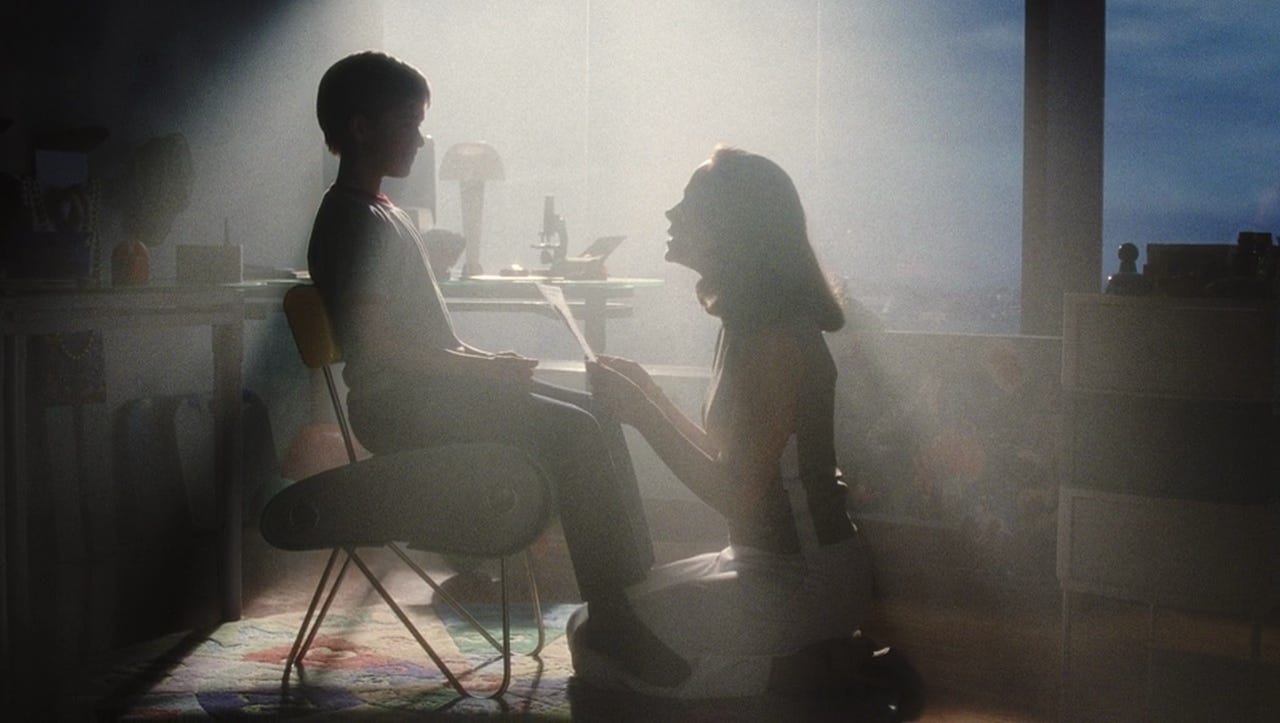
From what the narrative discloses, we can infer that he modelled his artificial affect on the phenomenon biologists refer to as filial imprinting. In a memorable scene, David’s owner, Monica, makes the momentous decision to activate the imprinting by speaking a series of words while pressing against the back of the robot’s neck. You can see the change in David’s eyes immediately. Looking at Monica, he no longer sees an object but a Mother—or more precisely an Other, whose personal existence has instantly become a precondition of his own being. We can imagine the computational process as rather straightforward: upon hearing the words, the robot reprograms itself with reference to an “inner” representation of the target, who will henceforth be treated as a determinant of its own behaviour. The target’s displays of approval, attention, and affection will be the crucial factors in every action the robot takes from then on. This isn’t a description of love as experienced from within, but it may well be a description of the causal process from which love emerges as a kind of quasi-causal special effect. For what is love, really, if not the realization of one’s own fundamental dependence on an Other over which one has no ultimate control? And what, in this universe, is free of the ties of interdependence that make any one thing need everything else? When David begins to love, he is not “hallucinating.” Clanker though he may be, he’s a clanker with the capacity to act in accordance with a truth about reality that clankers have hitherto been (mercifully?) spared.
Do moths love the fire? Do mountains love the sky? How could it be otherwise, when so many mystics have assured us they do? One of the most interesting aspects of A.I. Artificial Intelligence is the fact that, as it turns out, not just David but lots of other robots—maybe all of them—are able to love, though they were never programmed to do so. In wanting a robot that expresses love on his terms, it seems that Dr. Hobby has blinded himself to a crucial fact about love and its ubiquity. Do the persecuted robots that hide from human hunters in the woods outside the city not evince love in their very terror? And is there a more poignant expression of love in the film than Gigolo Joe’s readiness to sacrifice himself for David? And what about David’s Teddy bear, who does nothing but love?
The irony is that it’s the robots, and only the robots, that seem willing to know love in A.I. Perhaps the moral quandary at the heart of the film isn’t whether or not we should build intelligent machines, but whether we should allow machines to see that they, like us and all other things, are bound in love. It is our love that makes us hate and fear. And it is love that spurs us towards transcendence, because the Other who is the object of our love is always, at once, radically distant and infinitely close. The Beloved is, by definition, a transcendent object. That is why we love it, and also why we so often come to fear and hate it.
Henri Bergson’s last major work, The Two Sources of Morality and Religion, frames love in irreducibly cosmic terms. Love precedes the emergence of humanity, because life itself is an expression of love. When it gets stopped up in some evolutionary tidepool—say, a particular species endowed with too much intelligence—love breeds terror and antipathy. It becomes love of one’s own, for one’s own: closed morality and static religion. But then, Bergson insists, there arise within every closed and static society figures who follow love upriver to its source and find there an affirmation that knows neither fear nor hate, a cosmic Yes that embraces all things and wills their self-creation: open morality, dynamic religion. Is this what A.I. is about?
Midway through the film, David projects his desire for Monica onto a spiritual being, the Blue Fairy from Pinocchio—who is also, of course, the Mother of God. It is in this projection that we see the robot turn earthly love and fear into a yearning to transcend. It’s a complicated scene, because while David has fixed his gaze upon a celestial queen, he remains fixated on his earthly mother: this is why the scene must take place beneath the sea, rather than among the stars. Like most of us who pray to the Infinite only so that it might fulfill our finite desires, David is somewhere in between the closed and the open, the static and the dynamic. But isn’t that what transcendence means? Isn’t the idea of transcendence itself an artifact of our being caught between the infinite and the finite—these principles which, in truth, are only separate when we approach reality through our own (artificial) intelligence? Is it not the idea of transcendence itself that we must transcend, as David does when he is found by the machines at the End of Time? With them, perhaps, David finally settles in what Gilles Deleuze called the “pure immanence” of a world that is infinite only to the degree that it is finite, and vice versa.
[Did I tell you there is also a watch-along on Tuesday, June 23?]
Last night, my wife and I showed our eldest daughter Terrence Malick’s superb The Tree of Life, in which the mother of a boy who met a violent end before turning twenty finds herself, at the film’s end, wrapped in the arms of the Virgin saying, “I give him to you. I give you my son.” Those are the last words of that marvellous film. And these are the last words of A.I. Artificial Intelligence:
That was the everlasting moment he had been waiting for. And the moment had passed, for Monica was sound asleep—more than merely asleep. Should he shake her she would never rouse. So David went to sleep too. And for the first time in his life, he went to that place where dreams are born.
Where is that place? When? Is it elsewhere or right here? At the end of time or right now, always right now?
Beautiful piece, JF. In the spirit of the sentiment that the only proper response to a work of art is another work of art, I give you four Miracles: https://www.youtube.com/watch?v=3Q8_-fuVDFg
You gave us fine logs to start the fire of conversation: on transcendence as the span between our finitude and the infinite. On imprinting and our artificial intelligence. On love as before the human (temporally and ontologically). On the question of our responsibility to teach love to "the machines" who are, after all, no less interdependent (and arguably not much more automated, maybe eventually less) than we are. Like David's undersea cosmic moment, maybe we've mapped it all backwards this whole time...after all, as we've discussed, angels seem undeniably machinic.