Alone With the Alone
UFOs and the Art of Staying with Mystery

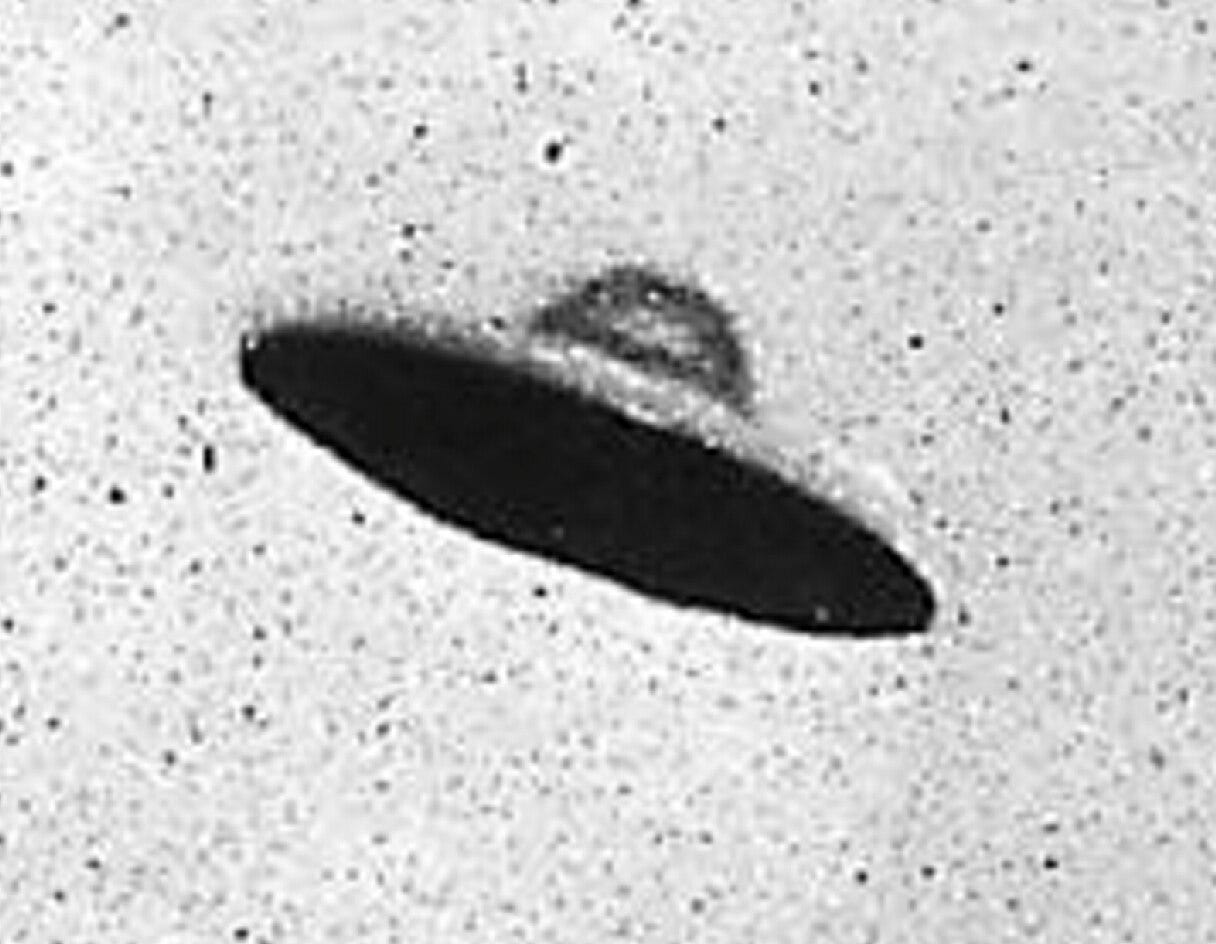
A finite game is played for the purpose of winning, an infinite game for the purpose of continuing the play.
—James P. Carse, Finite and Infinite GamesThere is but one infinite game.
— Ibid.
When I was in the seventh grade, I took part in a school trip to the Acadian coastal town of Bouctouche, New Brunswick, over a thousand kilometres from my hometown of Ottawa. On the way back, as our bus crossed the rural expanse west of Montreal, we saw a UFO. By “we” I mean at least half of the kids on the bus, as well as a teacher who, despite his oddly insistent refusal to look where we were pointing in the night sky north of the highway, later admitted that he had seen it too.
The object was large enough to show some definition, even as it flew quite close to a low-lying bank of clouds. It had several lights, orange and green in my memory. Some of these spun around the object like blinking lights on a pinball machine. It’s difficult now to say how long we watched it fly over the shadowed trees rushing past; my guess is that the entire episode was no longer than a minute. It ended when the thing suddenly shot upward at dazzling speed, disappearing into the clouds. It was only after it was gone that I realized it had projected a halo of light onto the underside of the cloud bank while it was within view.
Not surprisingly, I was convinced at the time that I had just been offered incontrovertible evidence of intelligent extraterrestrial life. This was the winter of 1989, in the age of SETI and Unsolved Mysteries. Spielberg’s E.T. and Close Encounters of the Third Kind were still recent memories, and Strieber’s Communion was still new. A few years earlier, my father had taken us to the drive-in to see The Last Starfighter, a film in which a young trailer-park inhabitant is enlisted by an army of good aliens waging war against an army of evil aliens. Though not a great piece of cinema by any measure, it had long been, for me, a source of fervent daydreaming. To us children of the eighties, there was a palpable sense that the night sky bristled with inhabited worlds, the human discovery of which was both predestined and imminent. Aliens seemed to us as real as ninjas, and even cooler.
Today I seldom daydream of ninjas. Nor am I so sure the night sky teems quite as much with life as I then thought it did. What my class saw that night is a mystery I no longer expect to see solved in any official way during my lifetime, if it ever will be.
Needless to say, our sighting was a drop in the bucket of such strange encounters. Since Carl Jung put the situation as simply as anyone can—“Things are seen in the sky,” he wrote in 1959—it seems we aren’t one step closer, seven decades and countless sightings later, to declaring with any degree of confidence what is seen, let alone why. To those who would respond here with claims of imminent official “disclosure,” of hard evidence of material technologies and non-human “biologics,” I can only say that I will be first in line to eat crow when the great moment comes. The thrill of learning that Earth is just one of many life-boasting worlds, and that humanity has finally matured to the point of being admissible to some interstellar confederation, would do more than compensate for the embarrassment of having been wrong on this point. But then the whole question would be moot. This essay would still have some value, provided I used a different example of strange experience—because if the UFO mystery were solved, it would never have been a mystery at all but only a problem, which is a very different thing. To paraphrase the French philosopher Gabriel Marcel, a problem is entirely external to me. Solving it might change my idea of the world, but that idea remains an abstraction, separate from me.1 A mystery, by contrast, can’t ever be solved, because the very terms of it change as I penetrate it. Every answer is a new question.
There was a time when all things seen in the sky elicited the wonder of mystery. For thousands of years, the fixed stars suggested to us a realm of permanence beyond the vale of shifting sorrows that is this earthly life; there was a kind of promise in the night sky. Most puzzling back then were the “wandering stars,” later identified as planets, whose trajectories betrayed the constancy of the rest of the firmament. Today, our fascination with the sky remains, though the discoveries of Galileo and his many followers have forced the fugitive glow of mystery into ever more specific aspects of it: first into comets and meteorites, then into lightning or the aurora borealis, then into St. Elmo’s fire, and finally, when all else had been rendered explainable in principle, into “unidentified anomalous phenomena,” whose behaviour suggests an intelligence comparable to that which we once ascribed to the stars themselves, when we descried angels behind their movements.
In a sense, with UFOs we arrive at the heart of the matter. What stills the heart in the phenomenon is less the relatively trivial question of whether or not aliens exist than the incontrovertible proof of intelligent life that the questioning itself provides—namely, proof that we earthlings sufficiently exist to wonder whether we are alone. The real wonder, the mystery, is our own existence (and that other life forms) on this particular ball of mud. The disclosure of a civilized planet orbiting Alpha Centauri wouldn’t make a lick of difference on this point. Indeed, it would only be a distraction.
I suppose what I am saying is that mysteries pertain more to meaning than to explanation, to Why than to What. But already I must pause here, for I may be too hastily reaching for Why. If I think about it, mystery pertains not so much to the reasons for existence—ours or the world’s—but to the brute fact of it. As Quentin S. Crisp put it to me in a recent letter: “That the world is has to do with its existence rather than its essence, and it is existence, then, rather than essence, that takes us most directly to the mystical or to ‘puzzlement’ in a philosophical sense.”2 Every answer to the question of why anything exists is downstream of that initial bafflement that it exists at all. Settling on a univocal “meaning” for existence, then, may be less a way of affirming mystery than another means of papering it over, the better to pretend it isn’t there.

But the spirit is weak here. There is something in me that wants a meaning for it all. If I go back to that moment in 1989 and let that something, that Ahab in me, take the helm, a wistful scenario unfolds, prompted by my earlier comparison of the object to a component from a pinball machine. I imagine the clouds parting to reveal that this was no mere analogy: the UFO really is just one component in a gigantic celestial pinball, one of many luminous structures arrayed on a semi-horizontal plane, a labyrinth of flying saucers. Into this playfield I launch the steel ball of my intellect. It navigates the labyrinth at lightning speed, its trajectory determined by a series of ricochets, every impact with a luminous structure changing, propelling it into another collision. Meanwhile, my will—perhaps my soul—remains alert, outside the game. Its task is threefold. First, it must keep the ball of intellect in play, smacking it back up into the maze when it comes too close to the sublunary pit and risks falling out of the game altogether. Second, it must attend to the tracers generated by the ball zigzagging through the scintillant maze, confident that these lines compose a new calligraphy by which Truth’s great glyph is being drawn. Lastly, it must keep an eye on an altogether different part of this celestial machine: the vertical backbox, perpendicular to the labyrinth, at the far end of my field of vision. It is utterly transcendent to the immanent playfield; the ball can’t go there. But it is there that the machine gives us the score—not just the numerical score assessing my performance on the playfield as compared to the current high-score holder (Plato, no doubt), but also the low-down, the point of it all, the name of the game: House of Diamonds, Lost World, Black Sheep Squadron, or Alien Star.
How neat would it be to find, behind the infinite game that is life in this universe, a finite game that one could play and potentially win? Again, I stress that I am speaking here from the Ahab in me. We humans are beset by an incessant spectacle, a technicolor cavalcade ceaselessly projected upon the phenomenal screen of the old Lebenswelt. When you realize that the real mystery is simply that a universe exists, all things collapse onto a single plane. Even the deepest parts of the universe, fathomless ocean or black hole, show that they have merely imaginal depth—that is, depths given on the surface along with everything else. “Nothing is hidden,” as Dōgen Zenji said, because there is nowhere for anything to hide.
Henri Bergson evokes just such a phenomenology of the surface at the beginning of Matter and Memory, when he describes the world as an infinite “aggregate of images.” Matter, Bergson writes, has no virtuality, meaning that it has no depth. I peel back one layer of matter only to find another; peel as I might, I am always confronted with more matter, always on the surface. Scientific discoveries into the workings of nature can make no difference here, not even those of fundamental physics. In Moby-Dick, it is this brute “facticity” of all things, the simple givenness of their appearance, that has driven Ahab mad. The captain has seen that no amount of _What_ will ever serve to solve the puzzle. Knowing the What of the White Whale, for him, matters only to the extent that he can use that knowledge to hunt it down and kill it:
At intervals, he would refer to piles of old log-books beside him, wherein were set down the seasons and places in which, on various former voyages of various ships, sperm whales had been captured or seen. … For with the charts of all four oceans before him, Ahab was threading a maze of currents and eddies, with a view to the more certain accomplishment of that monomaniac thought of his soul.
Melville’s tragicomic captain is determined to drive his harpoon right through the phantasmagorical screen of the Real. “If man will strike, strike through the mask!” he tells his crew. “How can the prisoner reach outside except by thrusting through the wall?” He would cut through the What to seize the Why beyond, as one might seize a lump of ambergris from the entrails of a dead whale. Even if the answer to the Why is “for nothing,” Ahab will be satisfied, because it’s an answer he wants, and any answer will do so long as it’s final.3 Ambergris, after all, can smell like shit or like roses; either way, it’s ambergris. Once Ahab has his lump of it, the phantasmagoria can go on all it wants; he can rest his head on the waxy, fecal substance and finally go to sleep.
To return to my topic (to which Moby-Dick is more relevant than some might suppose), it seems to me that UFO discourse is home to a lot of Ahabs. There are the “nuts-and-bolts” Ahabs, who insist that these are spacecraft piloted by extraterrestrials, and there are the “woo-woo” Ahabs, so-called, who dissolve everything into a single, capital-P “Phenomenon,” usually on the grounds that consciousness explains it all. By now it should be clear that I do not belong to either crew, though I am willing, as occasion demands, to board one ship or the other. But what interests me here is the leap in between, the condition of being unmoored, neither committed to one Pequod nor the other but simply at sea, in the position in which Melville leaves his narrator at the end of his novel. The question, then, is whether there is an Ishmaelian way of inhabiting mystery, a way of staying with mystery without degrading it, through empirical explanation or metaphysical inflation, into a problem to be solved.
Meaning is a gerund, a verb masquerading as a noun. It is Ishmael’s great strength that he seldom forgets this. The meaning of anything, for him, is whatever suggests that there is more to do, more to see, more to know. “I am tormented with an everlasting itch for things remote,” he tells us at the outset, blurring the distinction between torment and delight. Meaning is what keeps one going: it does not give reasons to die, but only to live another day. In other words, for Ishmael, meaning is entirely concerned with this world, this life, this story. Accordingly, I believe he would find equal cause for wonder in the image of a universe teeming with interstellar civilizations as he would in the image of one in which we humans and whales truly are alone.
In fact, it’s the latter image that has lately been eliciting from me the unmistakable chill of the weird. I remain struck by that scene in Lars von Trier’s Melancholia when Justine tells her sister, with apparent authority, that “life is only here on earth, and not for long.” There’s a kind of sublimity in the idea of a vast, empty cosmos existing for no reason other than to make us sense our solitude. As with any instance of the sublime, it’s full of horror, but also a kind of peace. The closing paragraph of R. H. Barlow’s “The Night Ocean,” written with H. P. Lovecraft, here comes to mind:
Vast and lonely is the ocean, and even as all things came from it, so shall they return thereto. In the shrouded depths of time none shall reign upon the earth, nor shall any motion be, save in the eternal waters. And these shall beat on dark shores in thunderous foam, though none shall remain in that dying world to watch the cold light of the enfeebled moon playing on the swirling tides and coarse-grained sand. On the deep’s margin shall rest only a stagnant foam, gathering about the shells and bones of perished shapes that dwelt within the waters. Silent, flabby things will toss and roll along empty shores, their sluggish life extinct. Then all shall be dark, for at last even the white moon on the distant waves shall wink out. Nothing shall be left, neither above nor below the sombre waters. And until that last millennium, as after it, the sea will thunder and toss throughout the dismal night.
No sooner have I settled into the horrible peace of this vision, however, than I remember that luminous object I saw when I was twelve. And no sooner do I remember that than I recall that, historically, UFO sightings have often been coupled with other kinds of experience, stranger and more difficult to accept. Some people have spotted a thing in the sky only to then find themselves suddenly aboard that thing, and there subjected to cruel experiments at the hands of humanoids of short stature. Others have watched the things land in their backyard and disgorge beings of terrible beauty, who spoke in riddles and then vanished. My friend Stuart Davis is on the record stating that he encountered robed, bipedal praying mantises who travelled in said things seen in the sky. There is an entire community devoted to encounters with the mantis people.
The reason Ishmael’s “itch for things remote” is “everlasting” is simply that no matter where you stand, on this planet or any other, there is always some shape on the horizon that you can barely make out, and which by its form beckons you to wonder what it is and why it is there. You’re always somewhere, beset by infinite elsewheres. Convince yourself that we are all alone, and a stranger appears to prove you wrong. The temptation is strong to hope this stranger, hailing from one of those elsewheres, knows the score, that they can tell you what lies behind the screen on which they and everything else appears. But the truth, I suspect, is that the stranger is as ignorant of ultimates as you are. They too are alone. They too wonder. They too look for signs in the heavens or on earth. According to the 2nd-century Neoplatonist Numenius, even a total union with the Divine leaves the mystic “alone with the alone.”
See Marcel’s Being and Having: An Existentialist Diary, pp. 117-121 in the 1965 Harper Torchbooks edition, translated by James Collins.
In his email, Quentin made it clear that by “puzzlement,” he meant what the Greeks called thaumazein. I highly recommend Quentin’s latest Substack essay, “First, Last and Middle Things.”
As Ahab says: “To me, the white whale is that wall, shoved near to me. Sometimes I think there is naught beyond. But ‘tis enough.”
"We incline to think that God cannot explain His own secrets, and that He would like a little information upon certain points Himself." -Melville, to Hawthorn (as you know)!
Lovely walk along the razor's edge.